
November 9, 2026
US markets are heading into an important week, with three major economic reports scheduled between Tuesday and Friday. Inflation will be the main focus, but investors will also be watching the latest employment data for clues about what the Federal Reserve might do next.
For cryptocurrency traders, the timing matters. Bitcoin is trading around $74,700 after losing roughly 4.5% over the past week. With uncertainty surrounding interest rates and institutional demand, upcoming US economic data could influence where the crypto market moves next.
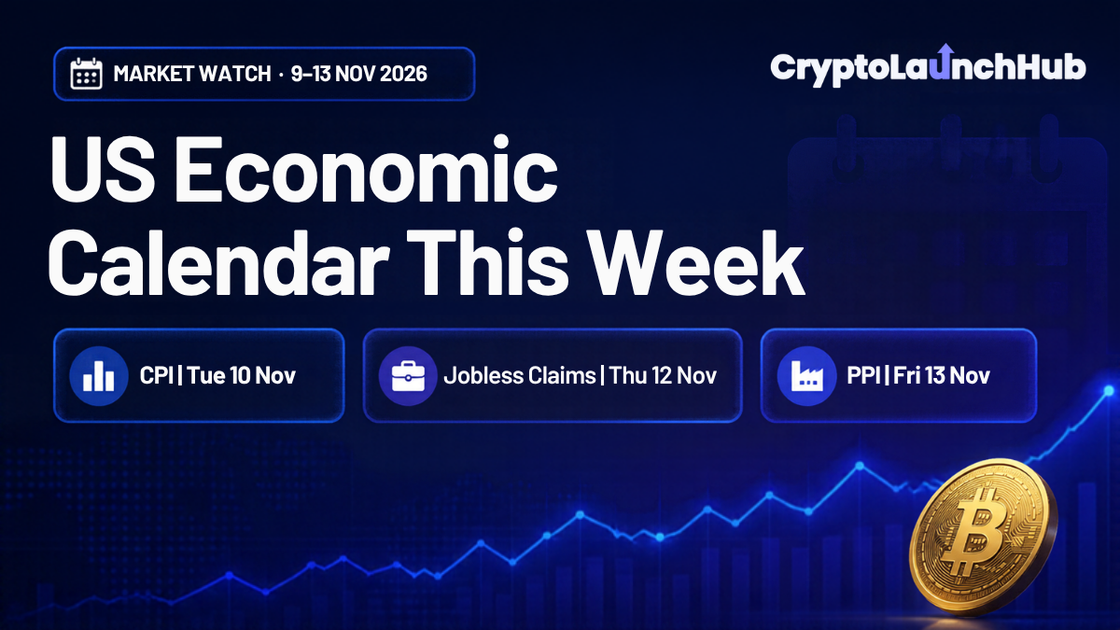
The biggest event is Tuesday’s October Consumer Price Index (CPI) report. Initial jobless claims follow on Thursday, while October Producer Price Index (PPI) data arrives on Friday.
Here’s the economic calendar for the week, what economists are expecting, and why these numbers matter for Bitcoin.
US Economic Calendar: November 9–13, 2026
Here are the main US economic releases to watch this week. All times are shown in Eastern Time (ET) and Indian Standard Time (IST).
| Date | Time (ET / IST) | Economic report | Forecast | Previous |
|---|---|---|---|---|
| Tue, Nov 10 | 8:30 AM / 7:00 PM | Headline CPI (MoM) | +0.3% | +0.6% |
| Tue, Nov 10 | 8:30 AM / 7:00 PM | Core CPI (MoM) | +0.2% | +0.3% |
| Thu, Nov 12 | 8:30 AM / 7:00 PM | Initial jobless claims | ~195,000 | 189,000 |
| Fri, Nov 13 | 8:30 AM / 7:00 PM | Headline PPI (MoM) | +0.4% | +1.3% |
Forecasts are market estimates and may change before publication. Previous figures refer to the preceding reporting period.
Tuesday’s CPI report is likely to attract the most attention because inflation remains an important factor in the Federal Reserve’s interest rate decisions.
Wednesday, November 11, is Veterans Day in the United States. The US bond market will be closed for the holiday, although the week also includes other scheduled economic and Federal Reserve-related developments.
1. US CPI Report on November 10: The Biggest Event This Week
The October Consumer Price Index will be the first major test for financial markets this week.
The CPI measures how prices for everyday goods and services change over time. It covers expenses such as housing, food, transportation, energy and healthcare.
Economists are expecting inflation to cool compared with September.
The current market estimates are:
- Headline CPI: 0.3% month over month, compared with 0.6% previously.
- Core CPI: 0.2% month over month, compared with 0.3% previously.
Core CPI excludes food and energy prices. Investors often pay close attention to it because these categories can move sharply from one month to another.
According to Bloomberg consensus figures cited by Kiplinger, the headline estimate is around 0.29%, while UBS expects approximately 0.26%. UBS also puts its core CPI estimate near 0.23%.
Energy prices are expected to account for much of the slowdown. UBS estimates that gasoline and other energy costs contributed 0.39 percentage points to September’s monthly CPI increase, compared with an expected contribution of just 0.04 percentage points in October.
However, not every part of inflation is cooling at the same pace.
Housing costs and services remain areas to watch. BMO has highlighted rent and airfare inflation as examples of price pressures that could keep underlying inflation elevated.
Why October’s CPI Report Is Different
There is another detail investors should understand before Tuesday’s release.
The US Bureau of Labor Statistics (BLS) will not publish most October 2026 year-over-year CPI comparisons.
Why?
During the 2025 government shutdown, the BLS could not collect October 2025 CPI survey data. As a result, the agency cannot calculate the usual 12-month inflation changes for most indexes that depend on those missing observations.
This means investors will have to pay particular attention to the monthly figures rather than relying on the usual annual inflation comparison.
For more details, see the official BLS explanation of the 2025 government shutdown’s impact on CPI.
2. Why the CPI Numbers Matter for the Federal Reserve
The Federal Reserve has a difficult balancing act. It wants to bring inflation under control without putting too much pressure on economic growth and employment.
The Fed raised its benchmark interest rate by 25 basis points in September 2026, taking the target range to 3.75%–4.00%. It then held rates steady at its October meeting.
Its next scheduled policy meeting is December 8–9.
Markets are now trying to determine whether another rate increase is likely in December.
A hotter-than-expected CPI reading could make the Fed more concerned about persistent inflation. That may strengthen expectations of higher interest rates and put pressure on assets such as Bitcoin, technology stocks and other risk-sensitive investments.
On the other hand, a softer inflation report could improve market sentiment and give investors some relief.
However, one cooler inflation reading does not automatically mean the Fed will change its policy. Officials will also consider employment figures and other economic indicators.
3. US Initial Jobless Claims on November 12
Thursday brings another important release: weekly initial jobless claims.
This report tracks the number of people filing for unemployment benefits for the first time. It offers a relatively quick look at changes in the US labour market.
The previous reading was 189,000 claims for the week ended October 31. Current market estimates point to approximately 195,000.
The report is particularly relevant after the latest US employment figures showed stronger-than-expected job growth.
The October jobs report recorded 165,000 new jobs, compared with expectations of approximately 65,000. The unemployment rate stood at 4.1%.
What should investors look for?
If jobless claims remain low, it could suggest that the labour market is still relatively strong. That may give the Federal Reserve more room to keep monetary policy restrictive.
If claims rise more than expected, it could point to a cooling labour market. Investors might interpret that as a reason for the Fed to take a less aggressive approach to interest rates.
For Bitcoin, the reaction will depend on the wider economic picture. Strong employment can support economic confidence, but it can also keep interest rate concerns alive.
4. October PPI Report on November 13
The final major release of the week is the Producer Price Index, scheduled for Friday.
While CPI measures price changes from the consumer’s perspective, PPI tracks prices received by domestic producers for their goods and services.
In simple terms, it provides a look at price pressures earlier in the production and distribution process.
September’s PPI report showed a 1.3% monthly increase, with prices rising 6.3% over the 12 months ending in September.
For October, the market expects a much smaller monthly increase of around 0.4%.
Investors will also watch core PPI, which excludes food and energy prices. The current estimate is around 0.3% month over month, compared with 0.7% previously.
If producer prices rise more than expected, businesses could face higher costs, potentially adding to concerns about persistent inflation.
A softer reading would support the view that price pressures are easing.
PPI is not a direct prediction of future consumer inflation, but it gives markets another piece of information when assessing the direction of inflation.
The BLS PPI release calendar confirms the November 13 publication date.
5. What Could This Week’s Economic Data Mean for Bitcoin?
Bitcoin’s next major move could depend partly on how investors interpret this week’s inflation and employment figures.
The cryptocurrency has already faced selling pressure. It ended the previous week around $74,700, down approximately 4.5%, after briefly falling towards $73,500.
US spot Bitcoin ETFs also recorded roughly $1.28 billion in net outflows during the week ending November 6.
We recently covered the factors behind this decline in our report: Why Is Bitcoin Dropping Today? ETF Outflows, Liquidations and CPI Ahead.
The upcoming economic releases could influence market sentiment in several ways.
If inflation comes in lower than expected:
- Investors may become more optimistic about the possibility of easing inflation.
- Treasury yields and the US dollar could come under pressure.
- Risk-sensitive assets, including Bitcoin, may receive some buying interest.
If core inflation comes in higher than expected:
- Expectations of another Fed rate increase could strengthen.
- Treasury yields and the US dollar may move higher.
- Bitcoin and other cryptocurrencies could face additional selling pressure.
If the results are mixed:
Markets may react differently depending on which parts of the reports surprise investors. For example, softer core CPI alongside stronger headline inflation could produce a more complicated reaction.
These are possible market reactions, not guaranteed outcomes. Bitcoin can move in either direction depending on positioning, liquidity and other developments.
Bitcoin Price Levels to Watch
With BTC trading around $74,700, traders are watching a few important price areas.
- $73,700–$74,000: Immediate support.
- $75,000: First resistance level.
- $76,000: Another important resistance area.
A sustained move above $75,000 could improve short-term sentiment. However, a break below the current support zone could bring renewed attention to lower price levels.
Economic releases can also cause sudden price movements, so traders should be careful about taking large leveraged positions immediately before the announcements.
What to Watch Before the Week Ends
The next few days will give investors a better understanding of whether inflation is cooling and whether the US economy is beginning to slow.
Here are the important dates:
- November 10: October US CPI report at 8:30 a.m. ET (7:00 p.m. IST).
- November 11: Veterans Day in the US; bond markets closed.
- November 12: Weekly initial jobless claims at 8:30 a.m. ET (7:00 p.m. IST).
- November 13: October PPI report at 8:30 a.m. ET (7:00 p.m. IST).
- November 18: Federal Reserve meeting minutes from the October meeting.
- December 8–9: Next Federal Reserve interest rate meeting.
Final Thoughts
This is an important week for financial markets, particularly for investors watching the Federal Reserve’s next move.
Tuesday’s CPI report will probably set the tone. Thursday’s jobless claims and Friday’s PPI figures will provide additional clues about the health of the US economy and the direction of inflation.
For Bitcoin traders, the main question is whether the incoming data will reduce interest rate concerns or give investors another reason to stay cautious.
With BTC already under pressure, even a small surprise in the inflation numbers could trigger a noticeable market reaction.
Rather than trying to predict every move, investors should watch the actual data, compare it with market expectations and be careful with leverage during periods of high volatility.
Disclaimer: This article is for informational and educational purposes only. It is not financial or investment advice. Economic forecasts are estimates, not confirmed results. Always conduct your own research before making investment decisions.
Sources
- US Bureau of Labor Statistics – November 2026 Release Schedule
- Kiplinger – October 2026 CPI Report: What to Expect
- FinancialJuice – US CPI Preparation, November 10
- Federal Reserve – September 2026 Interest Rate Decision
- Federal Reserve – FOMC Meeting Calendar
- Federal Reserve Bank of New York – November 2026 Economic Calendar
- Federal Home Loan Bank of New York – Weekly Market Update